Using
a natural, bioluminescent lure is a successful method of attracting prey, but
the lures come in many different forms. The family Oneirodidae, or dreamers, use
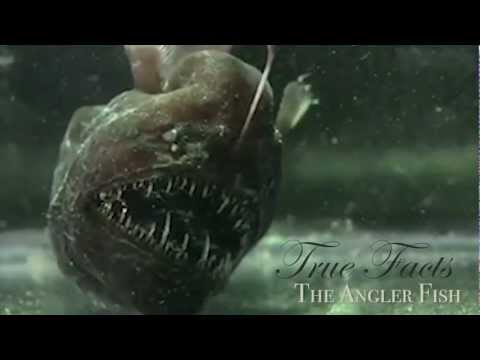
another variation of a modified dorsal spine as a lure, but it appears much
shorter than that of the average anglerfishes. In addition to their unique
illicium, members of Oneirodidae have several other adaptations giving them a
highly unique and slightly terrifying appearance.

Fig. 1 Bulbous Dreamer, Oneirodes eschrichtii - (http://fishesofaustralia.net.au/home/family/161)
Like
the Ceratioid seadevils, Oneirodidae fishes appear deep black in colour, diminishing
their visibility in water. With only the bright glow of the illicium, other
fish are instantly drawn toward the sneaky predators. Based on the scary appearance
of the various Oneirodidae fishes, it should not be surprising that they act as
predators.

Fig. 2 A female Longhead Dreamer, Chaenophryne longiceps, collected in the Tasman Sea on the 2003 NORFANZ Expedition (http://fishesofaustralia.net.au/home/family/161)
The fishes are
typically found between 11-29 centimetres and fall primarily on the shorter end
of the spectrum (Jónsson and
Palsson, 1999), but regardless of their smaller size, there is something
threatening about their appearance. Their globular bodies and short caudal and
pectoral fins look like an ineffective means of locomotion, but they somehow thrive
as ambush predators.

Fig. 3 Haenophryne melanorhabdus SL 52 mm with an attached parasite 15 mm long (http://tinyurl.com/mtwtwrk)
Oneirodidae fishes are
clearly doing well in means of survival, as they have been found throughout a
variety of waters. The first species was captured in 1973 off the west coast,
but have also been captured with bottom trawl in the Víkuráll area and
the southeast coast of Iceland (Jónsson and
Palsson, 1999). Of the deepsea anglerfishes, the family Oneirodidae is the
largest and most diverse family within the suborder Ceratioidei, but is also
the least well known (Pietsch, 1973). The different fish within this family may
hold another key to discovering information on how and when the evolution of
deepsea fishes occurred, but the elusive nature of Oneirodidaes poses a
challenge in studying their traits and behaviour.
References
Jónsson, G. and Palsson, J. (1999). Fishes of the suborder Ceratioidei
(Pisces: Lophiiformes) in Icelandic and adjacent waters. Rit Fiskideildar,
[online] 16, pp.197-207. Available at:
https://www.researchgate.net/profile/Jonbjorn_Palsson/publication/268435797_Fishes_of_the_suborder_Ceratioidei_Pisces_Lophiiformes_in_Icelandic_and_adjacent_waters/links/55ff43a808aeafc8ac8b9a25/Fishes-of-the-suborder-Ceratioidei-Pisces-Lophiiformes-in-Icelandic-and-adjacent-waters.pdf
[Accessed 25 Apr. 2017].
Pietsch,
T. (1973). A New Genus and Species of Deep-Sea Anglerfish (Pisces: Oneirodidae)
from the Northern Pacific Ocean. Copeia, [online] 1973(2), p.193.
Available at: http://www.jstor.org/stable/pdf/1442957.pdf [Accessed 28 Apr.
2017].
Fig. 1: Bray, D. (2017). Bulbous dreamer, Oneirodes eschrichtii. [image] Available at: http://fishesofaustralia.net.au/home/family/161 [Accessed 26 Apr. 2017].
Fig. 2: Bray, D. (2017). A female Longhead Dreamer, Chaenophryne longiceps, collected in the Tasman Sea on the 2003 NORFANZ Expedition. [image] Available at: http://fishesofaustralia.net.au/home/family/161 [Accessed 26 Apr. 2017].
Fig. 3: Prokofiev, A. (2017). Chaenophryne melanorhabdus SL 52 mm with an attached parasite 15 mm long:. [image] Available at: http://download.springer.com/static/pdf/17/art%253A10.1134%252FS0032945214050075.pdforiginUrl=http%3A%2F%2Flink.springer.com%2Farticle%2F10.1134%2FS0032945214050075&token2=exp=1493369269~acl=%2Fstatic%2Fpdf%2F17%2Fart%25253A10.1134%25252FS0032945214050075.pdf%3ForiginUrl%3Dhttp%253A%252F%252Flink.springer.com%252Farticle%252F10.1134%252FS0032945214050075*~hmac=e181919da3230f8a00e00f719afd2a421a17088e0505a0a6be432e500a921fe8 [Accessed 27 Apr. 2017].



Scary stuff! Who in their right mind decided that she should be called dreamers? Could you elaborate a bit more on their hunting strategy and their efficiency as predators?
ReplyDelete