The strange features of the
Lophiiformes extends far beyond their feeding adaptations. While many fishes
belonging to the order do have modified dorsal spines, other attributes are far
more bizarre. Arguably the strangest looking of the fishes is found in the family
Linophrynidae, consisting of 5 genera and 17 species (Pietsch, 1976).

Fig. 1 Soft Leftvent Angler (http://bit.ly/2p8jtPw)
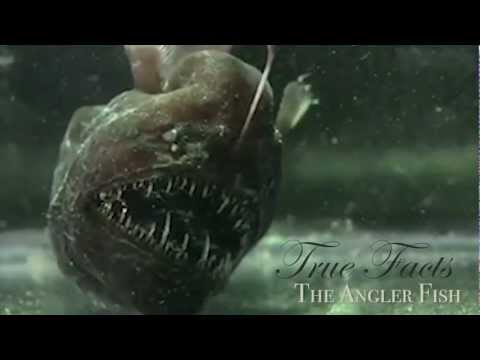
Linophrynidae, or leftvent anglerfishes, appear much
differently than other Lophiiformes. While they also have an illicium, it is short,
broadened and its length is lesser than that of the esca (Kharin, 2007). Like
Himantolophidae, or football fish, the left vent anglers have terminal papilla
(Kharin, 2007), small lumps of dermal tissue found within the mouth. Enhancing
the strange appearance, the fish have an ellipsoid body shape, rather than
globular like many other Lophiiformes, compressed laterally with naked, unarmed
black skin (Kharin, 2007). While they are noted to have black skin with a brown
shine, the fish tend to appear nearly clear, with a black portion appearing to
be almost internal (Fig 2).

Fig. 2 Soft
Leftvent Angler, Haplophryne mollis (http://bit.ly/2qHxGUG)
The fish are bathypelagic (Harte et al., 2008),
meaning they inhabit the deep sea where the environment is dark and cold.
Because of their preferred habitat type, little is known about the behaviours
of the peculiar fish, but their method of reproduction is well studied. The
male fishes, measuring much smaller than the females (Fig. 3), are parasites
that attach to all known gravid females (Pietsch, 1976). The free-living
linophrynid males display testes far less developed than in the parasitically
attached males, and the attached males, with larger testes, contain a notable
supply of spermatozoa (Pietsch, 1976).

Fig. 3 Close-up of the head of a preserved Soft Leftvent Angler, Haplophryne mollis, showing a tiny parasitic male attached to the top of her head (http://bit.ly/2qHxGUG)

Fig. 4 A tiny free-swimming male Soft Leftvent Angler, Haplophryne mollis, collected in the Sargoasso Sea (http://bit.ly/2qHxGUG)
The peculiarities of the fishes are bound to
continue beyond what meets the eye, but research has not yet unveiled the other
adaptations. Perhaps as research continues more information will be discovered,
but, until then, only the strange appearance of the fishes can be certainly noticed
as unique evolutionary adaptations.
References
Hartel, K., Kenaley, C.,
Galbraith, J. and Sutton, T. (2008). Additional Records of Deep-sea Fishes from
off Greater New England. Northeastern Naturalist, [online] 15(3),
pp.317-334. Available at: http://www.jstor.org/stable/pdf/25177116.pdf
[Accessed 4 May 2017].
Kharin, V. (2007). Finding a rare species of leftvent seadevils
Linophryne indica (Linophrynidae) near the Russian economic zone. Journal of
Ichthyology, [online] 47(2), pp.198-200. Available at: http://bit.ly/2p7M6x3
[Accessed 3 May 2017].
Pietsch, T. (1976).
Dimorphism, Parasitism and Sex: Reproductive Strategies among Deepsea Ceratioid
Anglerfishes. Copeia, [online] 1976(4), p.781. Available at:
http://www.jstor.org/stable/pdf/1443462.pdf [Accessed 3 May 2017].
Fig. 1: Australian Museum
(2010). Soft Leftvent Angler. [image] Available at:
http://bit.ly/2p8jtPw [Accessed 4 May 2017].
Fig. 2: McGrouther, M. (2017). Soft Leftvent Angler, Haplophryne
mollis. [image] Available at: http://bit.ly/2qHxGUG [Accessed 3 May 2017].
Fig. 3: Paul, D. (2017). Close-up of the head of a preserved Soft
Leftvent Angler, Haplophryne mollis, showing a tiny parastic male attached to
the top of her head. [image] Available at: http://bit.ly/2qHxGUG [Accessed
4 May 2017].
Fig. 4: Museum of Comparative Zoology, Harvard University (2017). A
tiny free-swimming male Soft Leftvent Angler, Haplophryne mollis, collected in
the Sargoasso Sea. [image] Available at: http://bit.ly/2qHxGUG [Accessed 4
May 2017].



No comments:
Post a Comment